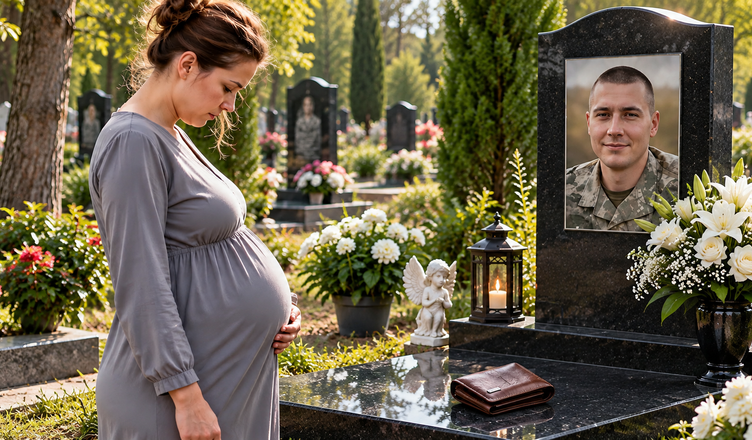
Emily had visited the cemetery every Sunday since her husband died.
At first, she went because staying home was unbearable. Later, the visits became a ritual. She would bring flowers, clean Daniel’s headstone and sit on the small bench nearby, sometimes talking aloud about ordinary things.
That Sunday, she was seven months pregnant.
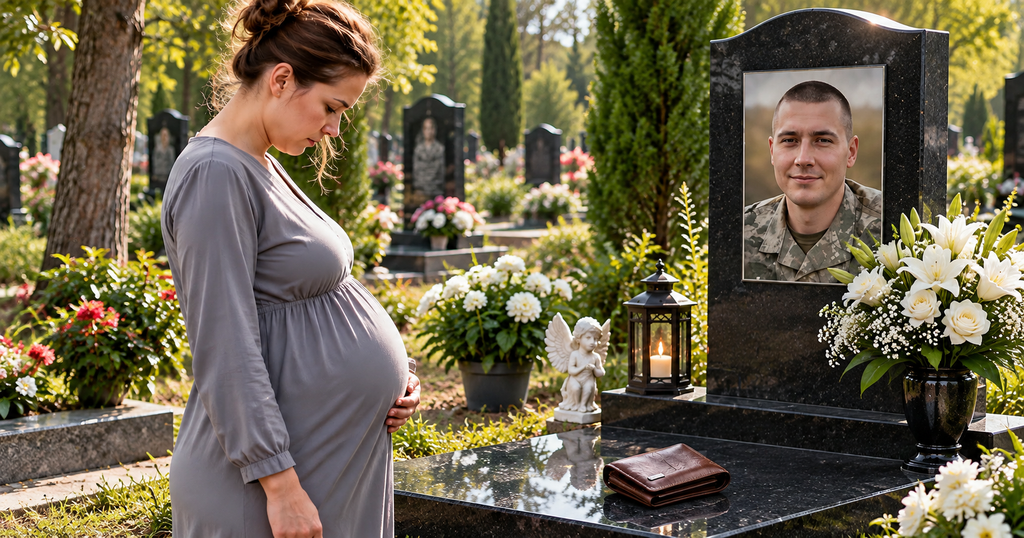
Daniel had known they were expecting a child before his sudden death, but he had died before learning whether they were having a boy or a girl.
Emily had imagined pregnancy very differently. There should have been arguments about names, furniture to assemble and late-night conversations about which parent the baby would resemble.
Instead, she was preparing for motherhood while grieving the man who should have been standing beside her.
Then she noticed the wallet.
It was lying in the grass less than two meters from Daniel’s grave.
This fictional story is inspired by the original premise. Its characters and events are invented rather than presented as a documented real-life case.
Something That Did Not Belong There
Emily almost ignored the wallet.
People visited the cemetery every day. Someone had probably dropped it and would eventually return.
But rain was expected that afternoon.
She picked it up, intending to take it to the cemetery office.
The leather was worn around the edges. Inside were some banknotes, two cards and a driver’s license.
The owner was a man named Robert Hayes.
Emily did not recognize the name.
Then she opened another compartment.
A photograph slipped onto the grass.
Emily bent down to retrieve it.
Her entire body went still.
Daniel was in the picture.
A Photograph She Had Never Seen
Her husband looked several years younger.
He was standing beside another man—presumably Robert—and between them was a teenage boy.
Daniel had one arm around the teenager’s shoulder.
All three were smiling.
Emily turned the photograph over.
There was a date from four years earlier.
Underneath, someone had written:
“Daniel, Robert and Luke. The day everything changed.”
Emily read the words twice.
Then a third time.
Who was Luke?
She and Daniel had been married for five years.
They had known each other for seven.
Daniel had never mentioned a teenager named Luke.
Her first reaction was not curiosity.
It was fear.
Grief Makes Uncertainty Feel Dangerous
During the months after Daniel’s death, Emily had learned how aggressively the mind fills empty spaces.
A delayed phone call became evidence something terrible had happened.
An unexplained receipt became a mystery.
A forgotten name suddenly seemed significant.
Grief had already taken away the person who could answer questions.
Now Emily was staring at a photograph that appeared to contain an entire part of Daniel’s life she knew nothing about.
She searched the wallet again.
Behind the photograph was a folded piece of paper.
This time, she hesitated before opening it.
It was not addressed to her.
Reading someone else’s private correspondence felt wrong.
But then she saw Daniel’s name.
Her hands began trembling.
“I Finally Went Back”
The note was brief.
It appeared to have been written by Robert.
He thanked Daniel for something he had done years earlier.
There were references to Luke, a hospital and “that night on the bridge.”
One sentence stopped Emily completely:
“If you hadn’t stayed with him until I arrived, I don’t know whether my son would still be here.”
Emily sat down beside Daniel’s grave.
The frightening possibilities she had imagined began to change.
The teenager in the photograph was apparently not Daniel’s secret child.
But another question replaced the first.
What had Daniel done?
And why had he never told her?
She Called the Number on the Card
Emily could have turned the wallet over to the cemetery office and walked away.
Instead, she used the phone number on Robert’s identification information to locate a contact through the proper channels.
When Robert answered, she explained that she had found his wallet.
There was a pause.
“Where?”
“At Greenfield Cemetery.”
Another silence.
“Near Daniel Miller’s grave?”
Emily’s heart began pounding.
“Yes.”
Robert exhaled.
“I’ve been looking everywhere for it.”
“Why were you visiting my husband?”
Robert did not answer immediately.
Then he asked a question of his own.
“Are you Emily?”
They Met at the Cemetery Office
Robert returned about forty minutes later.
He was in his late fifties and looked embarrassed as he thanked Emily for finding the wallet.
She handed it to him.
Then she held up the photograph.
“I need you to explain this.”
Robert looked at the image and immediately understood.
“Daniel never told you?”
“No.”
Robert sat down.
What he told her was not a secret romance, hidden family or betrayal.
It was a story about the kind of man Daniel had been when nobody was watching.
The Night on the Bridge
Four years earlier, Daniel had been driving home after working late.
Near a bridge outside town, he noticed a teenager sitting alone beyond the pedestrian barrier.
Daniel stopped.
The boy was Luke, Robert’s sixteen-year-old son.
Luke was in severe emotional distress.
Daniel did not know him.
He could easily have continued driving and assumed someone else would help.
Instead, he remained.
Robert explained that Daniel kept a safe distance, spoke calmly with Luke and contacted emergency services. He stayed until professionals and Luke’s family arrived.
Luke received treatment afterward.
The event became a turning point for the family.
Robert had wanted to publicly thank Daniel.
Daniel refused.
“He told me it wasn’t his story to tell,” Robert said.
Emily looked at him.
That sounded exactly like her husband.
Why Emily Had Never Heard About It
At first, she felt hurt.
Why would Daniel hide something so significant from his wife?
Robert offered an explanation.
Daniel believed Luke deserved privacy.
The teenager had gone through an intensely personal crisis. Daniel did not want the event turned into a heroic story about himself at the cost of exposing a vulnerable young person.
So he told Emily only that he had been delayed coming home that evening.
She remembered the night.
Daniel had arrived nearly three hours late.
When she asked what happened, he had said:
“Someone needed help.”
She had assumed there had been a broken-down car.
Now she understood.
The Photograph Came Later
After Luke had recovered and the family had regained some stability, Robert invited Daniel to lunch.
That was when the photograph had been taken.
Luke wanted Daniel to have a copy.
Daniel accepted one.
Robert kept another in his wallet.
Years passed.
Luke finished school and eventually moved away for university.
The families did not become close friends, but Robert occasionally sent Daniel updates.
Then he heard that Daniel had died.
He attended the funeral but did not approach Emily.
“I almost did,” he admitted.
“Why didn’t you?”
“You were pregnant. You had people around you. I didn’t think that was the moment to tell you another story about him.”
So Why Was the Wallet Beside the Grave?
Robert had visited Daniel’s grave that morning because it was the anniversary of the night on the bridge.
Luke had called him the previous evening.
They had talked about Daniel.
Robert decided to bring flowers.
While kneeling to place them near the headstone, the wallet must have slipped from his coat.
There was no hidden message.
No supernatural coincidence.
No deliberate attempt to leave the photograph for Emily.
It was simply a lost wallet.
And yet, through that ordinary accident, Emily discovered something about her husband that she might otherwise never have known.
The Discovery Did Not Make Grief Easier
People sometimes describe revelations about deceased loved ones as though they provide immediate comfort.
Emily’s reaction was more complicated.
She was proud of Daniel.
She was also angry.
Not because he had done anything wrong, but because there was now another memory she could never ask him about.
She wanted to know what he had said to Luke.
Whether he had been frightened.
Whether he had thought about the incident afterward.
Whether it had changed him.
Death had permanently closed those conversations.
Robert could provide facts.
He could not give Emily Daniel’s version.
That absence hurt.
Luke Eventually Wrote to Her
Several weeks later, Emily received a letter.
Robert had asked Luke whether he wanted to contact her.
Luke did.
He did not describe every detail of his crisis, and Emily respected that.
Instead, he wrote about Daniel.
He remembered that Daniel had not lectured him.
He had not demanded explanations.
He had simply remained nearby and kept talking until help arrived.
Luke wrote that one of the most important things Daniel had done was treat him like a person rather than a problem.
Emily read the letter several times.
Then she placed it in a box containing things she planned to show her child someday.
The Baby Would Know More Than a Name
Emily had worried constantly about how she would explain Daniel to a child who would never remember meeting him.
Photographs could show his face.
Videos could preserve his voice.
Family stories could describe his sense of humor.
But the wallet gave her something different.
It showed Daniel through a decision.
He had encountered a stranger in distress and stopped.
He had helped without expecting recognition.
Then he had protected the boy’s privacy so carefully that even his wife never learned what he had done.
That was the story Emily wanted her child to inherit.
Not because it transformed Daniel into a flawless hero.
He had not been flawless.
He left dishes in the sink.
He forgot appointments.
He could be stubborn.
They had argued like any couple.
But when a frightened teenager needed another human being to remain present, Daniel stayed.
What We Never Fully Know About the People We Love
Long relationships can create the illusion that we know everything important about another person.
We know how they take their coffee.
Which songs they hate.
What makes them angry.
How they sleep.
What they order at familiar restaurants.
But every person also has encounters, choices and quiet acts that may never become family stories.
Some are secrets.
Others simply never seem important enough to mention.
Daniel’s silence was not evidence of a second life.
It was evidence that he did not consider helping Luke to be his achievement to advertise.
The distinction mattered.
The Wallet Returned to Its Owner
Emily gave Robert everything back except the letter from Luke that arrived later.
She did not keep the photograph either.
Robert offered it.
Emily declined.
“You should keep it,” she said. “It belongs to Luke’s story.”
Months later, Emily gave birth to a healthy boy.
She named him Samuel, a name she and Daniel had discussed before his death.
When Samuel was older, she planned to tell him about his father.
There would be funny stories.
Embarrassing photographs.
Memories from their marriage.
And eventually, when he was old enough to understand, there would be the story of a wallet found beside a grave.
Not because the wallet contained a frightening family secret.
But because it revealed something quieter.
Emily had gone to the cemetery believing she was visiting everything that remained of Daniel.
A headstone.
Flowers.
Memories.
Then an object dropped accidentally into the grass reminded her that a human life extends beyond what one family sees.
Daniel had influenced someone she had never met.
Years after his death, that kindness was still moving through another family.
The wallet did not bring her husband back.
It gave her something grief had convinced her she would never receive again:
a new story about him.